Shri Mata Vaishno Devi University

Official Website     Last Updated: 27th Dec, 2025
11th Convocation
Shri Mata Vaishno Devi University
Official Website     Last Updated: 27th Dec, 2025
11th Convocation
Faculty of Engineering

School of Electronics & Communication Engineering

School of Electronics & Communication Engineering

In the contemporary era, electronics stands as the foremost domain of rapid technological advancement, characterized by unparalleled growth and continual evolution. It permeates every facet of engineering, spanning computer science, telecommunications, defense systems, mechatronics, instrumentation, automation, robotics, artificial intelligence, computer networks, satellite technology, and educational spheres. Electronics has precipitated a paradigm shift in global civilization, revolutionizing the very fabric of human existence.

The realm of communication has undergone a profound transformation, owing to the relentless progress in electronics. Presently, communication transcends geographical barriers, facilitated by computers, mobile devices, and satellite networks spanning vast expanses of land and sea. Yet, the horizon of possibilities remains boundless, with emerging technologies poised to further revolutionize communication, all rooted deeply in the foundational principles of electronics.

Vision & Mission

Vision:

  • To be a globally recognized centre in the field of electronics for preparing trained technical professionals with deep sense of integrity and an ingrained desire to contribute towards development of the society.

Mission:

  • To impart state-of-the-art education in the field of electronics through focused graduate, post-graduate and doctoral programs.
  • To provide opportunities to undertake research and contribute to intellectual knowledge base. Endeavour to apply the acquired knowledge into tangible benefits for the society.
  • Provide platforms for spreading the benefits of acquired knowledge for developing human potential and inculcating leadership qualities.

Objectives

The establishment of the School of Electronics & Communication Engineering aims to provide students with unparalleled training in electronics, equipping them to meet the rigorous demands of the fiercely competitive global industrial landscape. The objectives of the B.Tech. Programme encompass

  1. Providing a progressive training curriculum, covering fundamentals of electronics and advanced technologies in communication, digital design, and chip design.
  2. Cultivating curiosity among students towards electronics, fostering confidence in exploration and innovation.
  3. Developing students’ work ethics, organizational skills, teamwork abilities, and professionalism awareness.

Programmes Offered

  • B.Tech. (Electronics & Comm. Engineering)
  • M.Tech. (Electronics & Comm. Engineering)
  • Ph.D.

Program Outcomes

1. Engineering knowledge: Apply the knowledge of mathematics, science, engineering fundamentals, and an engineering specialization to the solution of complex engineering problem.
2. Problem analysis: Identify, formulate, review research literature, and analyze complex engineering problems reaching substantiated conclusions using first principles of mathematics, natural sciences, and engineering sciences.
3. Design/development of solutions: Design solutions for complex engineering problems and design system components or processes that meet the specified needs with appropriate consideration for the public health and safety, and the cultural, societal, and environmental considerations.
4. Conduct investigations of complex problems: Use research-based knowledge and research methods including design of experiments, analysis and interpretation of data, and synthesis of the information to provide valid conclusions.
5. Modern tool usage: Create, select, and apply appropriate techniques, resources, and modern engineering and IT tools including prediction and modeling to complex engineering activities with an understanding of the limitations.
6. The engineer and society: Apply reasoning informed by the contextual knowledge to assess societal, health, safety, legal and cultural issues and the consequent responsibilities relevant to the professional engineering practice.
7. Environment and sustainability: Understand the impact of the professional engineering solutions in societal and environmental contexts, and demonstrate the knowledge of and need for sustainable development.
8. Ethics: Apply ethical principles and commit to professional ethics and responsibilities and norms of the engineering practice.
9. Individual and team work: Function effectively as an individual, and as a member or leader in diverse teams, and in multidisciplinary settings.
10. Communication: Communicate effectively on complex engineering activities with the engineering community and with society at large, such as, being able to comprehend and write effective reports and design documentation, make effective presentations, and give and receive clear instructions.
11. Project management and finance: Demonstrate knowledge and understanding of the engineering and management principles and apply these to one’s own work, as a member and leader in a team, to manage projects and in multidisciplinary environments.
12. Life-long learning: Recognize the need for, and have the preparation and ability to engage in independent and life-long learning in the broadest context of technological change.

Program Specific Outcomes

Program Education Objectives (B.Tech.)

  • To progressively impart training starting from the fundamentals of Electronics and covering the entire spectrum of current technologies being used in the field of Electronics and Communication Engineering.
  • To inculcate a sense of curiosity in the students about the field of E&C and make them confident to explore and innovate.
  • To ensure that the students develop strong work ethics, organizational skills, team work and understand the importance of being a through professional.
  •  To develop integrity.

Program Specific Outcomes (B.Tech.)

  • PSO1: Proficiency in Electronics and Communication Systems
    Develop strong theoretical and practical expertise in the design, analysis, and implementation of advanced electronic systems and communication networks, with a focus on fostering technological solutions that meet the needs of the electronic and communication industry at the state and national levels.
  • PSO2: Innovation and Problem Solving in Emerging Technologies
    Leverage modern tools and methodologies to address real-world challenges in emerging areas such as IoT, AI, 5G communication, and VLSI design. Strive to deliver sustainable and impactful solutions that align with societal needs and uphold environmental values.
  • PSO3: Contribution to National and Global Technological Ecosystems
    Demonstrate technical competence and ethical responsibility while excelling in professional careers with government organizations or in leading private industries. Actively contribute to expanding the ecosystem of the electronics and communication sector and positively impact society.
  • PSO4: Lifelong Learning and Professional Integrity
    Cultivate research aptitude, interdisciplinary collaboration, and a commitment to lifelong learning, ensuring compassion, professionalism, and the preservation of human values in all endeavors within electronics, communication, and related domains.

Program Education Objectives ( M.Tech.)

  • To train students in the different research domains of E&C Engineering
  • To develop the competence of Analytical, Research and Developmental Skills with achievable goals
  • To prepare the students for professional, social and ethical responsibilities 

Program  Specific Outcomes ( M.Tech.)

  • PSO1: Applying Fundamental Knowledge:

Students should be able to apply their knowledge of ECE principles to design and implement solutions in diverse areas like VLSI, signal processing, communication, and embedded systems. 

  • PSO2: Technical Proficiency:

Students should demonstrate proficiency in using software and hardware tools, including simulation software, CAD tools, and specialized testing equipment. 

  • PSO3: Problem-Solving and Research:

Students should be able to identify, formulate, and solve complex problems in ECE, and conduct research to develop novel solutions. 

  • PSO4: Ethical and Professional Conduct:

Students should be able to demonstrate ethical behavior and professional responsibility in their work, considering the societal and environmental impact of their engineering solutions. 

Training Methodology

The program prioritizes experiential learning, with a substantial portion of the curriculum dedicated to practical application. Students engage with state-of-the-art equipment and apply classroom knowledge. Alongside traditional coursework, students refine skills through group discussions, presentations, and mandatory project work starting from the 5th semester. Continuous assessment evaluates their progress. Furthermore, students undertake summer training in industrial settings, gaining insights into project management, teamwork, quality assurance, and documentation adhering to industry standards. This comprehensive approach ensures students are equipped with not only theoretical knowledge but also practical competencies essential for their professional development.

Infrastructure

Additional Information

At the School of Electronics and Communication, University, we pride ourselves on providing a dynamic learning environment equipped with state-of-the-art facilities to nurture the next generation of innovators and engineers. Our infrastructure is designed to foster collaborative learning and hands-on experience, ensuring students are well-prepared for the challenges of the modern world.

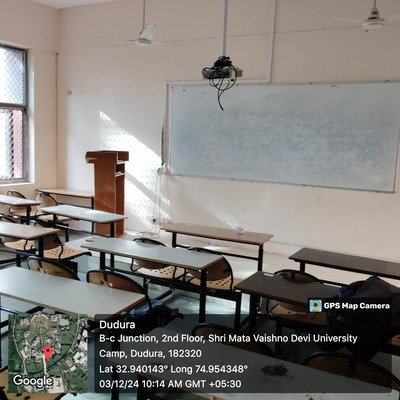
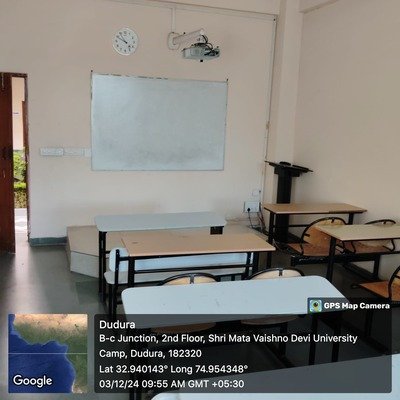
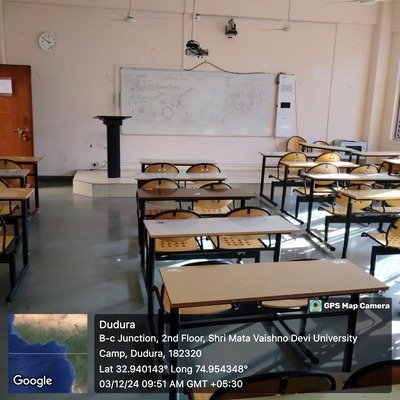
  • Interactive Classes: Our classrooms are equipped with advanced audio-visual systems, facilitating interactive learning experiences. Students actively engage with course material through multimedia presentations, discussions, and group activities, fostering a deeper understanding of concepts.
  • Tutorial Sessions: Complementing classroom learning, tutorial sessions offer personalized assistance and guidance to students. Led by experienced faculty members, these sessions provide opportunities for students to delve deeper into topics, ask questions, and clarify doubts in a supportive environment.
  • Laboratory Facilities: Our well-equipped laboratories provide students with hands-on experience in electronics and communication technologies. From basic circuit design to advanced networking experiments, students have access to cutting-edge equipment and software to reinforce theoretical concepts and develop practical skills.
  • Research Centers: The School houses dedicated research centers focusing on various aspects of electronics and communication engineering. These centers serve as hubs for innovation and discovery, providing students with opportunities to engage in groundbreaking research projects alongside esteemed faculty members.
  • Industry Collaboration: We have established strong ties with industry partners to offer students valuable insights into real-world applications and challenges. Guest lectures, industry visits, and internships provide students with exposure to the latest industry trends and practices, enhancing their employability and career prospects.
  • Career Development Resources: The School offers comprehensive career development resources, including resume workshops, mock interviews, and networking events. Our aim is to empower students with the skills and knowledge needed to succeed in their chosen careers upon graduation.

In summary, the School of Electronics and Communication at University offers a robust infrastructure designed to cultivate excellence in teaching, research, and industry engagement. From interactive classrooms to cutting-edge laboratories and industry partnerships, we are committed to providing students with a comprehensive education that prepares them for success in the ever-evolving field of electronics and communication engineering.


Student Internship Certificates

Department Notifications

TitleDateAction
MoM of Student Council meeting held on 24th November 202524/11/2025Download
Constitution of Class Committee for 1st Sem07/11/2025Download
Constitution of Class Committees in SOCE12/08/2025Download
Summer semester registration 2024-2512/06/2025Download

Faculty Profile

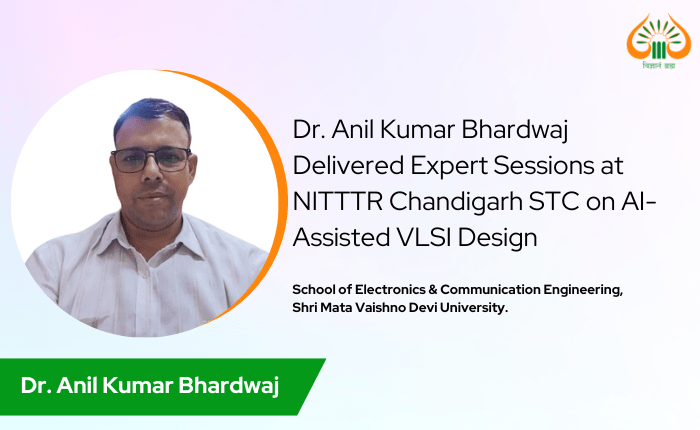
Dr. Anil Kumar Bhardwaj

Associate Professor
Head of School of Electronics & Communication Engineering
anil.bhardwaj[at]smvdu.ac.in
01991-285524 Extn.: 2333
More Detail

Dr. Kumud Ranjan Jha

Professor
Dean Faculty of Engineering
Head of School of Electrical Engineering
kumud.ranjan[at]smvdu.ac.in, jhakr[at]rediffmail.com
01991-285524 Extn.: 2329
More Detail

Dr. Amit Kant Pandit

Professor
amit.pandit[at]smvdu.ac.in, amitkantpandit@gmail.com
01991-285524 Extn.: 2332
More Detail

Dr. Sumeet Gupta

Professor
Faculty I/C Examinations
sumeet.gupta@smvdu.ac.in, sumeet1_gupta@rediffmail.com
01991-285524 Extn.: 2327, Phone: 9419201936
More Detail

Dr. Vikram Singh

Associate Professor
vikram.singh[at]smvdu.ac.in, vikram.jangra[at]gmail.com
01991-285524, 9466754797Extn.: 2244
More Detail

Dr. Vipan Kakkar

Associate Professor
vipan.kakar[at]smvdu.ac.in
01991-285524 Extn.: 2339
More Detail

Dr. Manish Sabraj

Associate Professor
manish.sabraj[at]smvdu.ac.in
01991-285524 Extn.: 2326
More Detail

Prof. Asok De

asok.de@smvdu.ac.in
Extn: 2241, Mobile: +919320697037
More Detail

Dr. Shashi Bhushan Kotwal

Associate Professor
kotwal.sb[at]smvdu.ac.in, sbkotwal[at]gmail.com
01991-285524 Extn.: 2331
More Detail

Mr. Ashish Suri

Assistant Professor (On Extra Ordinary Leave)
ashish.suri[at]smvdu.ac.in
01991-285524 Extn.: 2337
More Detail

Dr. Neeraj Tripathi

Assistant Professor
neeraj.tripathi[at]smvdu.ac.in, ntripathi[at]lycos[dot]com
01991-285524 Extn.: 2328
More Detail

Swastik

Assistant Professor
swastik[at]smvdu.ac.in
01991-285524 Extn.: 2340
More Detail

Dr. Purnima Hazra

Assistant Professor
purnima.hazra[at]smvdu[dot]ac[dot]in, purnimahazra26[at]gmail[dot]com
01991-285524, 9622273338 Extn.: 2344(O), 6344(R)
More Detail

Dr. Vijay Kumar Sharma

Assistant Professor ( On Extra Ordinary Leave)
vijay.sharma[at]smvdu.ac.in
01991-285524 Extn.: 2241
More Detail

Technical Staff Members

Mr. Gaurav Kumar

Laboratory Assistant
gaurav.kumar[at]smvdu.ac.in
More Detail

Er. Deepankur Gupta

Laboratory Assistant
deepankur.gupta[at]smvdu.ac.in
More Detail

Er. Pankaj Kumar Kataria

Laboratory Assistant
pankaj.kumar[at]smvdu.ac.in
More Detail

Mr. Narrotam Singh

Laboratory Assistant
narrotam.singh[at]smvdu.ac.in
More Detail

Mr. Munish Singh

Technical Assistant
munish.singh[at]smvdu.ac.in
More Detail

Mr. Sanjeev Wadhawan

Technical Assistant
wadhawansk[at]smvdu.ac.in
More Detail

Mr. Atul Sharma

Technical Assistant
atulneel.sharma[at]smvdu.ac.in
More Detail

Er. Bhawani Singh

Senior Technical Assistant
bhawani.singh[at]smvdu.ac.in
More Detail

Page last updated: December 16, 2025

Skip to content