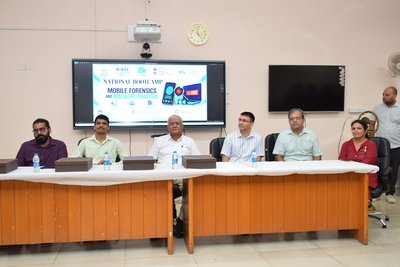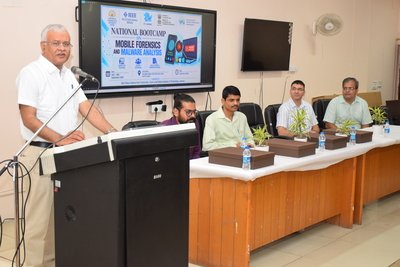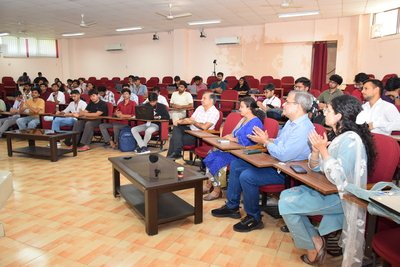
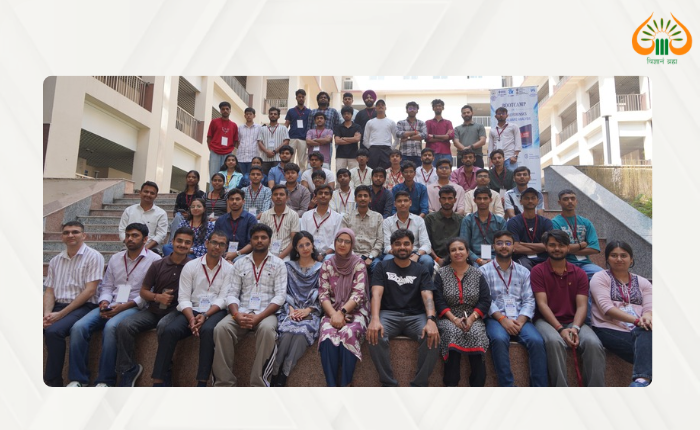
The five day National Bootcamp on Mobile Forensics and Malware Analysis, jointly organized by IIT Jammu and Shri Mata Vaishno Devi University (SMVDU), provided participants with an intensive academic and practical learning experience in the areas of mobile security, digital forensics, Android architecture, malware analysis, reverse engineering, network security, and machine learning-based malware detection.
The programme combined expert-led technical sessions with hands-on laboratory activities. Participants were introduced to mobile forensic concepts, Android security mechanisms, malware delivery techniques, static and dynamic APK analysis, reverse engineering, runtime monitoring, network traffic analysis, permission auditing, and machine learning approaches for Android malware detection.
The practical component enabled participants to work with isolated virtual environments and analysis tools, allowing them to examine Android applications in a controlled setting without compromising personal devices. The bootcamp concluded with technical assessments, a comprehensive quiz, a valedictory ceremony, and certificate distribution to eligible participants.
Daily Technical Proceedings
Day 1: 14/09/26
Inauguration, Introduction to Mobile Forensics & Real-World Threat Analysis
Venue: SMVDU Campus
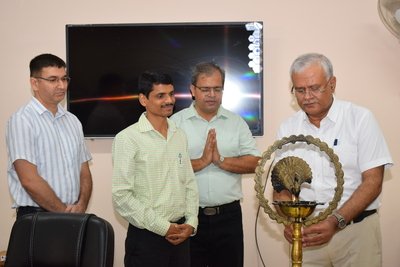
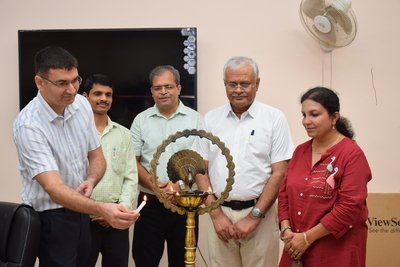
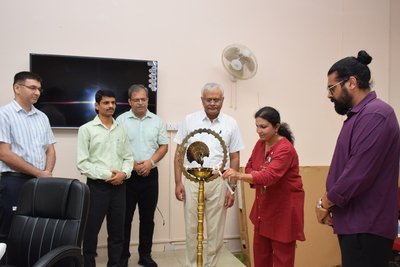
Session 1: Inaugural Address & Introduction to the Bootcamp
Speaker: Dr. Samaresh Bera
Dr. Samaresh Bera delivered the introductory address for the National Bootcamp on Mobile Forensics and Malware Analysis. He welcomed the participants and provided an overview of the bootcamp, its objectives, structure, and expected learning outcomes.
The session introduced participants to the broader relevance of mobile forensics and malware analysis in contemporary cybersecurity. Dr. Bera highlighted the importance of combining theoretical understanding with practical exposure and encouraged participants to actively engage with the technical sessions and laboratory activities scheduled throughout the programme.
The introductory session established the context for the five day bootcamp and provided participants with an overview of the topics and practical learning experiences that would follow.
Session 2: Real-World Threat Vectors, Incident Triage & Live Defense
Speaker: Dr. Sunil Kumar
Dr. Sunil Kumar conducted a case study oriented technical session focusing on common mobile security threats, attack vectors, and practical defensive measures.
The session covered several real world threat scenarios, including deceptive third party application sideloading, malicious QR codes or quishing, and multilingual smishing campaigns designed to deceive users.
Dr. Kumar also demonstrated an auditing platform used for examining application permissions, identifying potential command and control communication, and observing background application activity.
The discussion emphasized the importance of endpoint security practices, appropriate permission management, strong authentication practices, and continuous monitoring of suspicious application behaviour.
Participants were also introduced to the Mobile Security Toolkit prepared for the practical component of the bootcamp. The toolkit included a pre configured Android virtual environment, Genymotion, Oracle VirtualBox configurations, and APK analysis utilities, enabling participants to conduct controlled security exercises without using their personal devices.
Day 2: 15/09/26
Kernel-Level Monitoring, Android Internals & Static Triage
Venue: IIT Jammu Campus
Session 1: Kernel-Level Runtime Telemetry & Application Monitoring
Speaker: Mr. Ayush, IIT Jammu Research Team
Mr. Ayush demonstrated ongoing research related to mobile security and malware monitoring, focusing on low level runtime observation and Android system behaviour.
The session introduced participants to kernel level monitoring and explained how low level hooks can be used to observe system calls and identify suspicious activities originating from applications.
Participants were introduced to the concept of behavioural monitoring and how applications can interact with device resources such as sensors and cameras. The demonstration helped participants understand how security researchers can monitor application behaviour beyond what is visible through the conventional user interface.
Session 2: Android Architecture, Layered Security & Virtual Analysis Setup
Speaker: Mr. Shyam Sundar, Cisco Systems
Mr. Shyam Sundar provided an in depth overview of the Android operating system architecture and its various security layers.
The session covered the Android security stack, including the Linux Kernel, Hardware Abstraction Layer (HAL), Android Runtime (ART/Dalvik), and Application Framework. The speaker explained how applications interact with different layers of the operating system and how security vulnerabilities can potentially affect multiple layers.
Particular attention was given to Android permissions and the risks associated with granting applications unnecessary or high risk permissions, including access to the camera, microphone, SMS, and accessibility services.
The session also prepared participants for the practical laboratory exercises. Mr. Shyam Sundar guided participants through the configuration of virtual machines, VirtualBox, network interfaces, and related components required for the malware-analysis environment.
Day 3: 16/09/26
Practical APK Dissection, Reverse Engineering & Dynamic Traffic Analysis
Venue: IIT Jammu Campus
Intensive Hands On Lab: Malware Analysis & Reverse Engineering
Instructor: Mr. Shyam Sundar, Cisco Systems
Day 3 was dedicated primarily to practical malware analysis and reverse engineering activities. Participants worked in isolated virtual environments and disposable Android emulators to understand the workflow followed during Android application security investigations.
Static File Triage
Participants were introduced to the initial stages of APK analysis. They examined APK files, generated SHA-256 hashes, verified archive integrity, and inspected application contents using tools such as “unzip”, “file”, “aapt”, and “apktool”.
The Android Manifest file was examined to identify application components, exported activities, services, receivers, and potentially sensitive permissions.
Code Decompilation & Reverse Engineering
Participants used JADX-GUI to decompile DEX bytecode and examine application code in a more readable form.
The practical exercise involved searching application code for hardcoded strings, API related information, network endpoints, suspicious domains, and other indicators that could assist in understanding an application’s functionality and behaviour.
Dynamic & Behavioural Analysis
The session subsequently introduced participants to dynamic analysis techniques using Android Debug Bridge (ADB) and related tools.
Participants performed controlled application installation and execution, examined system logs using “logcat”, inspected application and device information using “dumpsys”, and simulated application interaction using automated input techniques.
Network analysis concepts were also introduced using tools such as Burp Suite and mitmproxy, allowing participants to observe application traffic within the controlled laboratory environment.
The instructor further introduced Frida and runtime instrumentation concepts for observing selected application behaviours, including file and cryptographic operations.
The hands on activities provided participants with practical exposure to the complete workflow of static and dynamic Android malware analysis.
Day 4: 17/0926
Ad-Hoc Network Resilience & Machine Learning in Android Malware Detection
Venue: Shri Mata Vaishno Devi University (SMVDU) Campus
Session 1: Secure Network Topologies & Architectural Access Control
Speaker: Prof. Ajay Koul, SMVDU
Prof. Ajay Koul conducted a technical session on mobile and ad hoc wireless network security.
The session introduced participants to the characteristics and security challenges of Mobile Ad Hoc Networks (MANETs), where network topology can change dynamically as mobile nodes join, leave, or move within the network.
The discussion covered potential security concerns associated with dynamic network environments, including malicious routing behaviour and man-in-the-middle attacks.
Prof. Koul also discussed the importance of network segmentation, controlled access, and appropriate privilege management for limiting unauthorized movement across interconnected systems and mobile enterprise environments.
Session 2: Android Malware Detection Using Machine Learning & Obfuscation Analysis
Speaker: Dr. Monika Sharma
Dr. Monika Sharma conducted a detailed session on modern approaches to Android malware detection, with particular emphasis on machine learning, deep learning, and code obfuscation techniques.
The session introduced common techniques used to make malicious applications more difficult to analyze, including string obfuscation, reflection, dynamic payload loading or decryption, and the use of native libraries.
Dr. Sharma explained how machine learning and deep learning models can be applied to malware classification by extracting features from Android applications.
These features may include declared permissions, intent filters, API call sequences, application behaviour, and system-level activity. Participants were introduced to the relationship between feature extraction, classification, and the detection of potentially malicious applications.
The session demonstrated how conventional static analysis can be complemented by ML/DL based approaches when dealing with large numbers of applications and evolving malware families.
Day 5: 18/09/26
Advanced Permission Auditing, Technical Assessments & Valedictory Ceremony
Venue: Shri Mata Vaishno Devi University (SMVDU) Campus
Morning Session: Permission Forensics & Technical Assessment
Speaker: Dr. Monika Sharma
The final day began with a technical session conducted by Dr. Monika Sharma focusing on Android runtime permissions and permission auditing.
The session reviewed how Android applications request and utilize permissions and discussed how combinations of permissions can provide applications with extensive access to device resources.
Participants were introduced to automated auditing approaches for examining permissions and monitoring their usage on connected devices.
Morning Technical Quiz
A technical assessment was conducted to evaluate participants’ understanding of the concepts covered during the bootcamp.
The assessment included questions related to Android security architecture, permission models, reverse engineering concepts, malware behaviour, analysis methodologies, and security evasion techniques.
Afternoon Session: Comprehensive Quiz
A Grand Comprehensive Quiz was conducted during the afternoon session. The quiz assessed participants’ understanding of the complete five-day curriculum.
The assessment covered major areas including:
- Mobile and digital forensics
- Android security architecture
- APK static analysis
- Dynamic and behavioural analysis
- Reverse engineering
- Network traffic analysis
- Permission auditing
- Malware detection
- Machine learning and deep learning approaches
- Malware obfuscation and evasion techniques
The quiz provided an opportunity for participants to consolidate and demonstrate the knowledge acquired throughout the bootcamp.
Valedictory Ceremony & Certificate Distribution
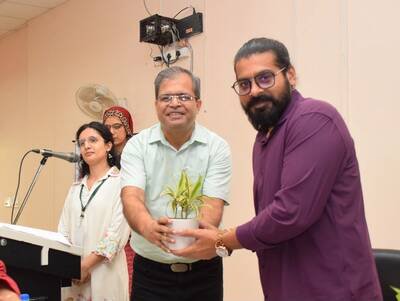
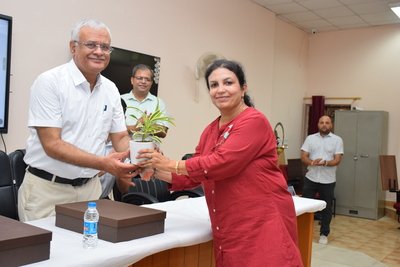
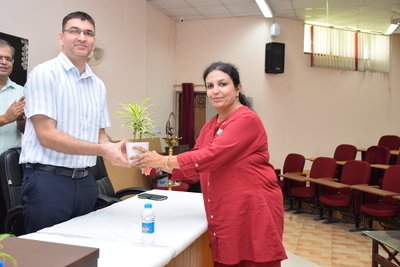
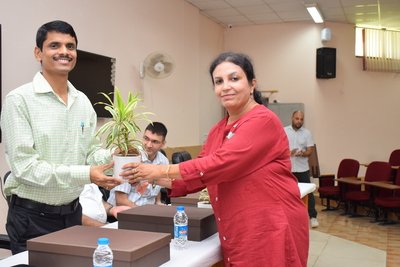
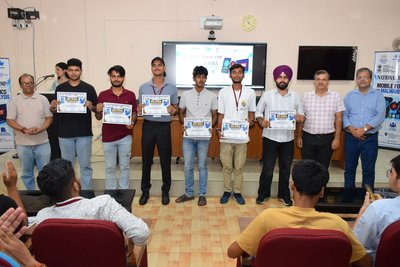
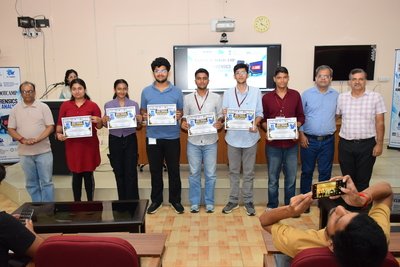
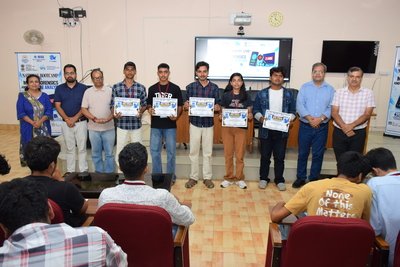
The bootcamp concluded with a formal Valedictory Ceremony attended by institutional representatives, resource persons, coordinators, faculty members, and participants.
The ceremony acknowledged the active participation and efforts of the attendees throughout the five day programme. Certificates were distributed to eligible participants who successfully fulfilled the programme requirements, including participation in the scheduled sessions, laboratory activities, and assessments.
The organizers expressed their appreciation to all the resource persons and supporting teams whose contributions made the programme a success
The organizing team also expressed gratitude to the faculty coordinators, laboratory and technical support staff, administrative teams, student coordinators, and all participating students for their cooperation and active involvement.
A formal Vote of Thanks marked the conclusion of the programme, acknowledging the collective efforts of IIT Jammu and SMVDU in conducting the National Bootcamp on Mobile Forensics and Malware Analysis.
Overall Learning Outcomes
The five day bootcamp provided participants with exposure to both foundational and advanced aspects of mobile cybersecurity. By the end of the programme, participants had gained practical and conceptual understanding of:
- Fundamentals of mobile forensics and digital evidence handling.
- Android operating system architecture and security mechanisms.
- Mobile malware delivery and common attack vectors.
- Android permission models and permission auditing.
- Static analysis of Android APK files.
- APK decompilation and reverse engineering workflows.
- Dynamic and behavioural malware analysis.
- Android debugging and runtime monitoring.
- Network traffic inspection and analysis.
- Malware persistence and evasion concepts.
- Mobile and ad-hoc network security.
- Machine learning and deep learning approaches to malware detection.
- Code obfuscation and malware-analysis challenges.
- Practical use of isolated virtual environments for cybersecurity research.
Conclusion
The National Bootcamp on Mobile Forensics and Malware Analysis, held from 14 to 18 September 2026, successfully brought together academic instruction, expert demonstrations, practical laboratory exercises, technical assessments, and collaborative learning.
The programme provided participants with a structured understanding of the mobile cybersecurity ecosystem, progressing from introductory concepts and Android architecture to practical APK analysis, reverse engineering, dynamic monitoring, network security, and ML/DL-based malware detection.
The combination of sessions conducted at SMVDU and IIT Jammu enabled participants to gain exposure to both academic research perspectives and practical cybersecurity workflows. The hands on activities further strengthened the participants’ ability to apply theoretical concepts within controlled laboratory environments.
The bootcamp concluded with assessments, a comprehensive quiz, a valedictory ceremony, and certificate distribution, marking the successful completion of a five-day programme focused on developing awareness, technical understanding, and practical skills in mobile forensics and malware analysis.